Red sand, cold river,
blue lagoon.
A camp of tents on a dune looking straight at Uluṟu, a lodge on the fast, clear Waikato near Lake Taupō, and an atoll north of Tahiti where the resort runs largely on sunshine and seawater. This is the far side of the world from Spain, so we focus on timing, on the long way there and on doing fewer things for longer.
- Countries
- Australia, New Zealand and French Polynesia, an overseas collectivity of France
- Money
- Australian and New Zealand dollars; the CFP franc in Tahiti
- Languages
- English and te reo Māori; French and Tahitian; Pitjantjatjara and Yankunytjatjara around Uluṟu
- Clocks
- Uluṟu UTC+9:30, New Zealand UTC+12 (UTC+13 in summer), Tahiti UTC−10
- Plugs
- 230V Type I in Australia and New Zealand; 220V Type E in French Polynesia
- When
- Uluṟu May to September; New Zealand December to April; Tahiti May to October
- From Madrid
- No nonstops; one or two connections via the Gulf, Asia, Paris or North America
- Paperwork
- Australian eVisitor or ETA, New Zealand's NZeTA; EU citizens enter Tahiti freely
Worth the long way round
Few journeys from Spain are longer than this one, which is exactly why we suggest doing it slowly. The three hotels here sit thousands of kilometers apart and show three completely different Pacific worlds.
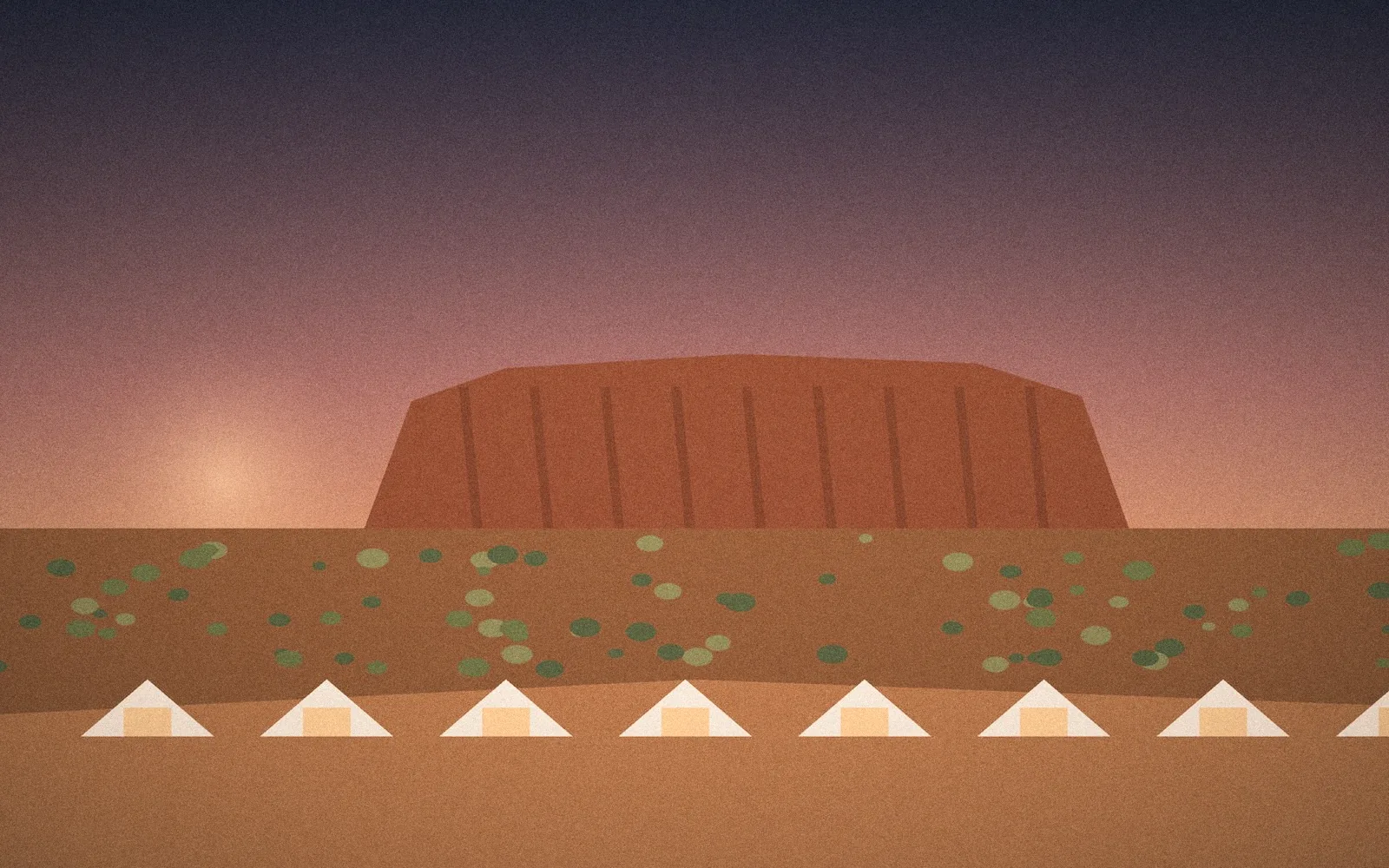
Longitude 131° is a camp of sixteen tented pavilions on a dune at the edge of Uluṟu-Kata Tjuṯa National Park, homeland of the Aṉangu. Every tent faces the rock, and the light changes it from rust to violet through the day.
Huka Lodge started in the 1920s as a fishing camp on the banks of the Waikato, just upstream of the roar of Huka Falls, and anglers still come for the trout. The Brando is on Tetiaroa, the atoll Marlon Brando bought in the 1960s; its villas line white sand and the island runs on solar power and a deep-seawater cooling system.
Best for: once-in-a-lifetime trips and honeymoons, fly fishers, walkers, divers and anyone curious about Aboriginal, Māori and Polynesian cultures.
Picking your months
South of the equator, the calendar runs the other way round from Spain. Each of the three has its own best window, and they overlap more than you might expect.
- Uluṟu: the cooler months, May to September, bring warm days and nights that can drop below freezing. From December to February, afternoons are often over 35°C and walks close early in the heat.
- Taupō: summer (December to February) suits the Tongariro Alpine Crossing and lake swimming. March and April are settled and less busy. Trout fishing on the river is possible all year; check current rules with the lodge.
- Tetiaroa: May to October is the drier, breezier season. November to April is hotter and wetter, the cyclone season, though direct hits on the Society Islands are uncommon.
If you want one trip for all three, aim for September or October: comfortable days in the desert, spring in New Zealand, and dry weather in the islands.
Getting there from Spain
There are no nonstop flights from Spain to this part of the world. For Australia and New Zealand, most people from Madrid or Barcelona connect through a Gulf hub such as Doha or Dubai, or through Singapore or another Asian hub; count on well over 24 hours door to door. Tahiti is usually reached via Paris, on flights that stop in North America, or via Los Angeles.
Once in the region, things are simpler. Ayers Rock Airport has direct flights from Sydney, Melbourne and Brisbane. Taupō has a small airport linked to Auckland and Wellington. Air Tahiti Nui and Air New Zealand connect Auckland and Papeete, and The Brando flies guests to Tetiaroa in its own small planes.
| Leg | How | Time | Worth knowing |
|---|---|---|---|
| Madrid to Sydney | Flight with one stop | ≈ 24h+ | Via Doha, Dubai or an Asian hub |
| Sydney to Ayers Rock | Flight | ≈ 3h 30m | Camp transfer about 10 minutes |
| Sydney to Auckland | Flight | ≈ 3h | Frequent service |
| Auckland to Taupō | Flight or drive | ≈ 1h / 3h 30m | The drive can include Waitomo or Rotorua |
| Auckland to Papeete | Flight | ≈ 5h | You cross the date line and land the previous day |
| Papeete to Tetiaroa | Resort plane | ≈ 20m | Booked through the hotel |
Two weeks, west to east
- 1
Uluṟu · 3 nights at Longitude 131°
Fly from Madrid to Sydney, then on to Ayers RockDawn at the base of the rock, the Valley of the Winds at Kata Tjuṯa, and a night of desert stars.
- 2
Taupō · 4 nights at Huka Lodge
Fly Ayers Rock to Sydney, Sydney to Auckland, then on to TaupōA morning on the river with a fishing guide, the Tongariro Crossing on a clear day, and an afternoon at Rotorua's thermal parks.
- 3
Auckland · 1 night
Fly back to AucklandBreak the journey: ferries on the harbor, or a day out to Waiheke Island.
- 4
Tetiaroa · 5 nights at The Brando
Fly to Papeete, arriving on the previous calendar day, then the resort planeSwim, snorkel the lagoon and visit the seabird colonies on the motu, then head home via Paris or Los Angeles.
Doing it the other way round, out via North America and back via Asia or the Gulf, turns the trip into a loop around the globe. Many airlines sell it as a single round-the-world ticket.
Respect and good manners
- At Uluṟu: this is a living cultural landscape. Climbing has been banned since October 2019, and signs mark sacred places where photography is not allowed. Follow them.
- Māori custom: if you are welcomed onto a marae, let your hosts lead. A hongi, touching noses and foreheads, shares breath as a greeting.
- Tipping: not part of the culture in any of the three places. Leave something extra only when service has truly stood out.
- Customs checks: Australia and New Zealand take biosecurity seriously. Declare food, plant material and muddy boots or fishing gear, or face heavy fines.
- Sun: the UV index is extreme for much of the year. A wide hat, sunglasses and reef-safe sunscreen are essentials.
- In Tahiti: a tiaré flower worn behind the left ear means taken; behind the right, available.
What to look for
Native ingredients
Wattleseed, quandong, lemon myrtle and finger lime, often on tasting menus in the desert.
Barramundi
A mild, flaky fish, best simply grilled with a squeeze of lime.
Hāngī
Meat and root vegetables wrapped and cooked for hours on hot stones in a pit.
Whitebait fritters
Tiny translucent fish bound with egg and fried, a spring treat.
Your own trout
Wild trout cannot be sold in New Zealand, so the only way to eat it is to catch it; lodges will cook your catch.
Poisson cru
Diced raw tuna with lime, cucumber and fresh coconut milk.
Po'e
A sticky baked pudding of banana, papaya or pumpkin, finished with coconut cream.
Vanilla
Plump Tahitian pods, especially from Taha'a, used in sauces as much as in desserts.
Places worth a detour
Kata Tjuṯa
A group of 36 domed rocks; the Valley of the Winds walk weaves between them.
Kings Canyon
A rim walk above sandstone walls, best in the cooler months.
Huka Falls
The whole Waikato squeezes through a narrow chasm in a torrent of blue-white water.
Tongariro Alpine Crossing
A full-day hike past volcanic craters and emerald lakes; book a shuttle.
Rotorua
Geothermal valleys, boiling mud and evenings of Māori culture.
Mo'orea
Steep green peaks, two bays and good snorkeling inside the reef.
Sydney Harbour
The Opera House, the coastal walk from Bondi, and a ferry to Manly.
Three houses across the Pacific
Pick a tab for each house's full file: the rooms, a three-day outline, where to eat, what to do, how to arrive, the weather month by month and the small practical things.
Our Oceania hotels side by side
Oceania: frequently asked
How many days should I allow?
From Spain, two weeks is the minimum to enjoy all three. The flights alone take two or three days of the trip, and each hotel deserves at least three nights.
Is there one good season for all three?
September or October comes closest. The desert is mild, New Zealand is greening up for spring, and Tahiti is still in its dry season.
Can I climb Uluṟu?
Not any more. The traditional owners asked visitors not to climb for many years, and it was closed for good in October 2019. Walk around the base instead; it is the better experience.
How does the date line work?
Flying east from Auckland to Papeete, you arrive the day before you left. Booking a hotel for the wrong night is a common mistake, so check dates twice.
Can we bring children?
The Brando welcomes families, and Huka Lodge can host them too. Longitude 131° has age limits; check with each hotel before booking.
What entry papers do Spanish travelers need?
An eVisitor for Australia (free for EU citizens) and an NZeTA for New Zealand, both applied for online. French Polynesia is part of France, so EU citizens enter with a passport or ID card. Confirm rules before you travel.